
(Full, SEO-Friendly & AdSense Safe Article)
—
🌍 Introduction
World War I, also known as The Great War, was one of the most important and devastating conflicts in human history. It began in 1914 and ended in 1918, involving more than 70 million soldiers and changing the political map of the world forever.
This war caused the fall of empires, the rise of new nations, and set the stage for World War II.
Understanding World War I is necessary to understand the modern world.
—
🔥 Causes of World War I
Although the war started with one assassination, the real causes were deeper and more complex. Historians describe the main causes with four key factors:
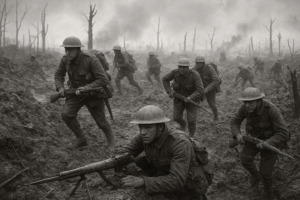
1️⃣ Militarism
European nations had been building massive armies and weapons. Military pride and power made nations ready for war.
2️⃣ Alliances
Europe was divided into two powerful alliance systems:
Triple Entente (Allied Powers): France, Russia, Britain
Triple Alliance (Central Powers): Germany, Austria-Hungary, Italy
These alliances meant that a conflict between two countries could drag many more into war.
3️⃣ Imperialism
European powers competed for colonies in Africa and Asia. This competition created tension and rivalry.
4️⃣ Nationalism
Strong nationalism encouraged countries to prove their power.
In the Balkans, especially Serbia, nationalism was extremely high.
🕊️ The Assassination That Sparked the War
On June 28, 1914, Archduke Franz Ferdinand, heir to the Austro-Hungarian throne, was assassinated in Sarajevo by a Serbian nationalist.
Austria-Hungary blamed Serbia and declared war.
Within days, alliances activated, and the entire continent was at war.
⚔️ Major Powers in the War
🌐 Allied Powers
France
Britain
Russia (until 1917)
Italy (joined 1915)
United States (joined 1917)
Japan + several smaller nations
🛡️ Central Powers
Germany
Austria-Hungary
Ottoman Empire
Bulgaria
These nations fought across Europe, Africa, the Middle East, and the oceans.
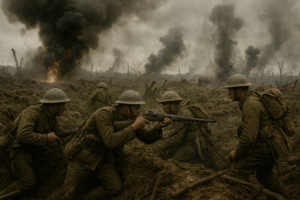
🕳️ Trench Warfare: Life in the Trenches
Most battles took place on the Western Front, where both sides dug deep trenches.
Life in the trenches was extremely hard:
Mud and water everywhere
Rats and disease
Constant fear of attacks
Artillery shelling day and night
Very slow movement of front lines
This war introduced new technologies:
Machine guns
Poison gas (chlorine, mustard gas)
Tanks
Submarines (U-boats)
Heavy artillery
Early aircraft
These inventions made World War I unlike any war before.
—
🇺🇸 The United States Joins the War (1917)
At first, the U.S. stayed neutral.
But Germany’s submarine attacks on American ships forced the U.S. to join the Allies in 1917.
American troops brought:
Fresh soldiers
Money
Supplies
This gave the Allies a powerful advantage.
—
❗ Russia Withdraws (1917)
In the same year, Russia left the war because of the Russian Revolution.
The new government signed peace with Germany.
But the loss of Russia was balanced by the arrival of the U.S.
—
🕊️ The End of the War
On November 11, 1918, Germany requested an armistice.
This date is now remembered as:
Armistice Day / Remembrance Day
The war officially ended in 1919 with the signing of the Treaty of Versailles.
—
📜 The Treaty of Versailles
The treaty imposed very harsh punishments on Germany:
Heavy war reparations (billions of dollars)
Loss of territory
Military limitations
Blame for causing the war (War Guilt Clause)
These harsh conditions later helped Adolf Hitler rise to power.
—
💔 Human Cost of the War
World War I caused massive destruction:
16 million deaths
Entire cities destroyed
Widespread famine
Millions of soldiers wounded
Psychological trauma (Shell Shock)
The world had never seen such a deadly war before.
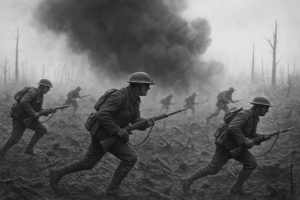
🌏 The Legacy of World War I
The war changed the world forever:
The German Empire collapsed
The Ottoman Empire ended
The Austro-Hungarian Empire broke into many countries
Russia became the Soviet Union
New borders were created
The League of Nations was formed
Conditions were created for World War II
The modern world was shaped by the consequences of World War I.
—
🧠 Conclusion
World War I was more than just a battle between nations—it was a turning point in global history. It reshaped political systems, destroyed empires, introduced modern warfare, and changed the lives of millions.
Understanding this war helps us understand how the world reached its modern shape.