
The history of the United States is a complex and evolving story shaped by diverse cultures, major conflicts, rapid expansion, and powerful social movements. Long before European arrival, the land was home to countless Indigenous nations—including the Navajo, Cherokee, Iroquois, Sioux, and many others—each with rich cultural traditions, advanced agricultural systems, and well-defined political structures. These societies lived on the continent for thousands of years and formed the earliest chapters of American history.
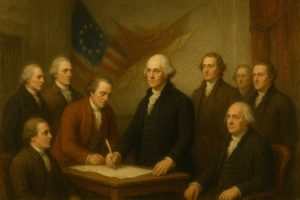
European exploration began in the late 15th and early 16th centuries, followed by waves of colonization in the 1600s. British, French, Spanish, and Dutch settlements spread across the continent, driven by trade, agriculture, and the search for new opportunities. Tensions grew between the American colonists and the British Crown over issues such as taxation, governance, and economic control. These tensions eventually led to the outbreak of the American Revolution.
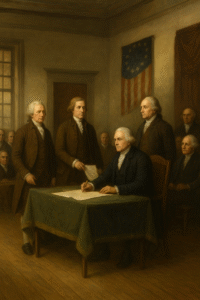
On July 4, 1776, the Continental Congress adopted the Declaration of Independence, officially marking the birth of the United States of America. After years of conflict, the new nation secured its freedom and began shaping a constitutional government. The U.S. Constitution, adopted in 1787, introduced a federal system built on principles of separation of powers, representation, and individual rights.

During the 19th century, the United States underwent dramatic territorial expansion through purchases, treaties, and conflicts—eventually stretching from the Atlantic to the Pacific. However, this period was also marked by deep national divisions, especially over the issue of slavery. These tensions culminated in the American Civil War (1861–1865), a devastating conflict between the Northern Union states and the Southern Confederacy. The Union’s victory ended slavery nationwide and redefined the nation’s commitment to equality, though true civil rights would remain an ongoing struggle for generations.
Following the Civil War, the United States entered a period of rapid industrialization. Railroads, factories, and new technologies transformed the economy, attracting millions of immigrants from Europe and Asia. By the early 20th century, the U.S. had become a major world power, playing decisive roles in both World War I and World War II.
After World War II, the country emerged as one of the two global superpowers, entering the ideological and geopolitical rivalry known as the Cold War. Meanwhile, at home, the mid-20th century became a turning point for social justice. The Civil Rights Movement, led by figures such as Martin Luther King Jr., challenged segregation and discrimination, laying the foundation for future reforms and expanding the meaning of American democracy.
In recent decades, the United States has continued to evolve as a leader in technology, science, culture, and global politics. Its society is distinguished by remarkable diversity, with people from every region of the world contributing to its cultural and social landscape. Today, the nation’s history is understood as a blend of triumphs and struggles—an ongoing narrative shaped by innovation, conflict, migration, and the pursuit of freedom.