
The Ottoman Empire was one of the most powerful, long-lasting, and culturally influential empires in world history. For more than 600 years, it shaped the political, economic, and cultural landscape of three continents: Europe, Asia, and Africa. The story of the Ottoman Empire is a journey of conquests, diplomacy, culture, science, and eventual transformation into modern Turkey.
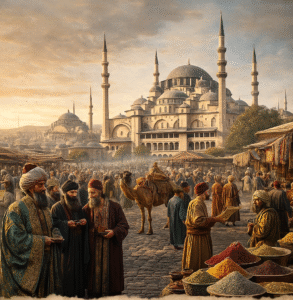
🔥 Origins and Early Expansion (1299–1453)
The empire began in 1299 under the leadership of Osman I, a Turkish tribal leader in Anatolia. His small principality slowly grew as the Byzantine Empire weakened, and neighboring states fought among themselves.
During this early period:
The Ottomans expanded across Northwestern Anatolia
They built strong military forces
They created alliances with local powers
They captured key Byzantine towns
By the mid-14th century, the Ottomans crossed into Europe, marking the start of their rise as a major regional power.
⚔️ The Conquest of Constantinople (1453)
One of the most important events in world history was the fall of Constantinople.
Under Sultan Mehmed II (Mehmed the Conqueror), the Ottomans captured the city after a long and strategic siege.
This event resulted in:
The end of the Byzantine Empire
The transformation of Constantinople into Istanbul, the new Ottoman capital
A shift in global economic routes
The rise of the Ottomans as a world empire
The city became a center of culture, science, trade, and architecture.
🌍 The Golden Age of the Empire (16th Century)
The reign of Suleiman the Magnificent (1520–1566) is considered the empire’s golden age.
During this period:
The empire expanded into the Middle East, North Africa, and Southeastern Europe
Its influence stretched across three continents
Architecture flourished under the famous architect Mimar Sinan
Arts, literature, law, and science advanced significantly
The economy grew strong due to trade routes and agriculture
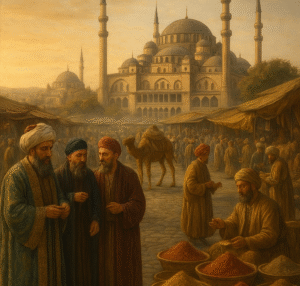
Istanbul became a global capital, filled with mosques, markets, schools, and cultural institutions.
📉 Years of Struggle and Decline (17th–19th Century)
After its peak, the empire faced internal and external challenges:
Internal Problems:
Corruption
Weak sultans
Economic troubles
Outdated military systems
External Pressures:
European nations growing stronger
Loss of territories in the Balkans
Rising nationalist movements
Military defeats in major wars
By the 19th century, the empire became known as “the Sick Man of Europe.”
🕊️ Collapse After World War I and Birth of Modern Turkey
World War I had devastating consequences for the Ottoman Empire. After fighting alongside Germany and Austria-Hungary, the empire faced defeat.
Key outcomes:
Loss of nearly all remaining territories
Occupation of Istanbul by Allied forces
Rise of the Turkish National Movement
In 1923, Mustafa Kemal Atatürk abolished the empire and established the Republic of Turkey, marking the start of a new era.
Atatürk introduced major reforms:
Modern education
Latin alphabet
Secular government
New legal system
Industrial and social modernization
These reforms transformed Turkey into a modern nation-state.
🧠 The Legacy of the Ottoman Empire
Even after its fall, the empire continues to influence the world.
The legacy lives on in:
Modern Turkey’s culture, architecture, and language
The Balkans, where Ottoman heritage is still visible
The Middle East, shaped by Ottoman administration
North Africa, influenced by Ottoman rule
The empire’s history remains one of the richest and most fascinating chapters in human civilization.