
Iran, historically known as Persia, is home to one of the world’s oldest and most enduring civilizations, with cultural and political traditions that reach back more than seven millennia.
From the earliest settlements on the Iranian plateau, ancient peoples shaped a land that would later become a cradle of art, science, and empire.
Among the first organized powers were the Elamite kingdoms, whose influence spread across southwestern Iran and laid the foundations of early Iranian identity.
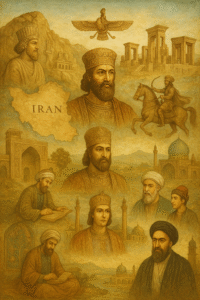
In the 6th century BCE, Cyrus the Great rose to prominence and established the Achaemenid Empire—an empire renowned for its unprecedented scale, administrative innovation, and respect toward the customs and religions of the peoples it governed.
Under rulers such as Darius I and Xerxes, Persia became a symbol of grandeur, connecting lands from the Indus Valley to the Mediterranean through vast road networks and remarkable architectural achievements like Persepolis.
Centuries later, the Parthian Empire emerged, famous for its skilled cavalry and resistance against Roman expansion.
The Sasanian Empire followed, ushering in a golden age of art, literature, and diplomacy that made Iran a central power in the ancient world.
Following the arrival of Islam in the 7th century, Iran became one of the most important centers of Islamic philosophy, poetry, astronomy, and medicine.
Persian scholars, poets, and scientists—such as Ferdowsi, Avicenna, and Rumi—shaped not only Iranian culture but also the intellectual traditions of the entire world.
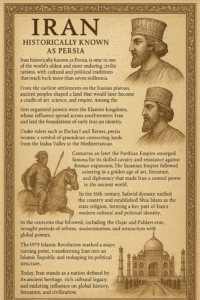
In the 16th century, the Safavid dynasty unified the country and established Shi’a Islam as the state religion, forming a key part of Iran’s modern cultural and political identity.
The centuries that followed, including the Qajar and Pahlavi eras, brought periods of reform, modernization, and interaction with global powers.
The 1979 Islamic Revolution marked a major turning point, transforming Iran into an Islamic Republic and reshaping its political structure.
Today, Iran stands as a nation defined by its ancient heritage, rich cultural legacy, and enduring influence on global history, literature, and civilization.SIA