
Canada’s history stretches across thousands of years, beginning long before European contact and continuing through centuries of political, cultural, and social transformation. The story of this vast northern land is shaped by Indigenous civilizations, waves of exploration and colonization, the struggle for self-governance, and the development of a diverse modern nation.
Indigenous Beginnings
Long before Canada became a country, the land was home to rich and sophisticated Indigenous societies. First Nations, Inuit, and Métis peoples lived across forests, plains, coasts, tundra, and river valleys. Each group developed distinct languages, belief systems, governance structures, and trade routes.
From the Haudenosaunee Confederacy in the east to the Plains Cree in the center and the Inuit communities of the Arctic, these nations maintained complex relationships with both the land and one another. Their agricultural, hunting, and navigational knowledge laid the foundation for survival in environments ranging from dense woodlands to frozen polar regions.
Early European Exploration
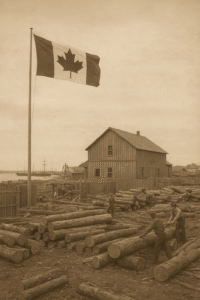
European interest in North America increased in the 15th and 16th centuries. Norse explorers had reached parts of the Atlantic coast centuries earlier, but sustained contact began when explorers like John Cabot (sailing for England) and Jacques Cartier (for France) arrived.
French expeditions were particularly influential. By the early 1600s, Samuel de Champlain established settlements along the St. Lawrence River, most notably Quebec City. These outposts became centers for the fur trade — an economic engine that shaped early relations between Europeans and Indigenous nations. Many alliances, as well as conflicts, formed during this period as trade networks expanded.
Colonial Rivalry: France and Britain
Throughout the 17th and 18th centuries, France and Britain competed for control of North America. New France grew through settlements in the St. Lawrence Valley, the Great Lakes region, and parts of the Prairies. Meanwhile, British colonies expanded along the Atlantic coast.
This rivalry reached a turning point during the Seven Years’ War (1756–1763), a global conflict that also unfolded in North America. The British captured key French strongholds, including Quebec in 1759. With the Treaty of Paris (1763), France ceded most of its North American territories to Britain, reshaping the political landscape of the continent.
Toward Confederation
After gaining control, Britain reorganized its new territories into provinces such as Quebec, Nova Scotia, and later Upper and Lower Canada. These regions developed unique cultures and political identities. Throughout the early 19th century, debates over language, religion, and governance led to reforms and, at times, rebellions.
By the 1860s, several colonies recognized the need for greater unity. Economic pressures, defense concerns, and the desire for self-government drove leaders to pursue a new political framework. In 1867, the British North America Act created the Dominion of Canada, uniting Ontario, Quebec, Nova Scotia, and New Brunswick under a federal constitution. Over the next century, other provinces and territories gradually joined the Confederation, completing the map of modern Canada.
Nation-Building and Expansion
The late 19th and early 20th centuries were marked by rapid growth. The construction of transcontinental railways linked distant regions, supported population movement, and encouraged immigration from Europe and Asia. Agricultural settlements expanded across the Prairies, while coastal regions developed strong fishing and shipping industries.
However, this expansion also brought challenges. Indigenous communities were displaced, residential schools harmed generations of children, and political decisions often ignored the rights of original inhabitants. These issues remain central to ongoing efforts toward reconciliation.
Canada in the Modern Era
Canada emerged as a more independent nation during the 20th century. Its contributions during the First and Second World Wars strengthened its international reputation. The Statute of Westminster (1931) granted greater autonomy, and the Constitution Act of 1982 fully established Canada’s legal independence by introducing a home-grown constitution and the Charter of Rights and Freedoms.
Post-war immigration reshaped society, bringing new cultures, languages, and economic growth. Canada gradually adopted policies that embraced multiculturalism, bilingualism (English and French), and human rights as national values.
Contemporary Canada
Today, Canada is recognized for its political stability, peaceful international relations, and diverse population. Its economy draws strength from natural resources, technology, education, and global trade. At the same time, the nation continues to prioritize reconciliation with Indigenous peoples, environmental protection, and inclusive social policies.
Canada’s history is ultimately a story of many peoples — Indigenous nations, European settlers, immigrants from around the world — all contributing to the development of a country known for cooperation, resilience, and cultural diversity.