
Saudi Arabia is one of the most historically significant regions in the world. Located on the Arabian Peninsula, it is the birthplace of Islam and home to two of the holiest sites in the religion: Mecca and Medina. The history of this land spans thousands of years, shaped by ancient tribes, trade routes, empires, and the rise of Islam.
—
🌍 Early History of the Arabian Peninsula
Before the rise of Islam, the Arabian Peninsula was home to various tribes and civilizations.
Key features of early Arabia:
Nomadic Bedouin tribes
Trade caravans passing through Mecca
Worship of many gods before Islam
Important trade centers like Mecca and Taif
Mecca was an important commercial and religious hub long before Islam emerged.
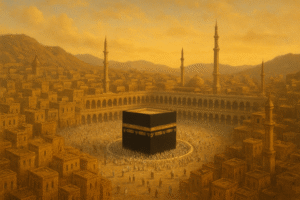
🌙 The Rise of Islam (7th Century CE)
The most transformative event in Arabian history was the birth of Islam in the 7th century.
🔸 Prophet Muhammad (peace be upon him)
Born in Mecca in 570 CE, Prophet Muhammad began receiving revelations that would form the Quran. His teachings transformed society, ending tribal conflicts and uniting the region under one God.
Important events:
Hijra (Migration) to Medina in 622 CE
Establishment of the first Islamic state
Unification of Arabian tribes
Conquest of Mecca in 630 CE
After the Prophet’s death, the region became the center of a rapidly expanding Islamic empire.
—
🕌 The Islamic Caliphates
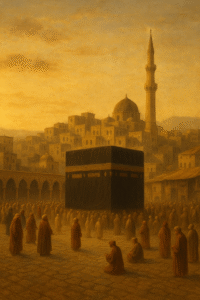
After Islam spread beyond Arabia, the peninsula remained religiously important but politically less dominant.
Still, Mecca and Medina stayed as spiritual capitals for Muslims worldwide.
The region was influenced by:
Umayyad Caliphate
Abbasid Caliphate
Later tribes and local rulers
Despite political changes, the Arabian Peninsula protected Islamic traditions, scholarship, and pilgrimage routes.
—
🌴 The First Saudi State (1744–1818)
The modern history of Saudi Arabia begins with the alliance between:
Muhammad ibn Saud (leader of Diriyah)
Muhammad ibn Abd al-Wahhab (Islamic scholar)
Together they established the First Saudi State, promoting religious reform and uniting tribes under one authority.
The state expanded rapidly but was eventually defeated by the Ottoman-Egyptian forces.
—
🌴 The Second Saudi State (1824–1891)
After the fall of the first state, the Second Saudi State was formed in Riyadh.
This period included:
Restoration of Saudi leadership
Tribal conflicts
Struggles for survival
The state collapsed after internal disputes, but the Saudi family survived and remained influential.
—
🦅 The Unification of Saudi Arabia (1902–1932)
The founder of modern Saudi Arabia is King Abdulaziz Al Saud (Ibn Saud).
Key events:
In 1902, he recaptured Riyadh
United Najd, Hijaz, and other regions
Fought tribal battles and made alliances
Established control over Mecca and Medina
On September 23, 1932, the Kingdom of Saudi Arabia was officially proclaimed.
This date is now celebrated as Saudi National Day.
—
💎 Discovery of Oil (1938) – A New Era
One of the most important events in Saudi history was the discovery of oil in 1938.
Oil transformed the kingdom:
Massive economic growth
Foreign investment
Development of cities like Riyadh, Jeddah, and Dhahran
Modern highways, airports, universities
Creation of ARAMCO (now one of the biggest companies in the world)
Saudi Arabia became a major global economic and political power.
—
🕌 Saudi Arabia and the Islamic World
Saudi Arabia is home to:
Masjid al-Haram (Mecca)
Masjid an-Nabawi (Medina)
Millions of Muslims visit the kingdom every year for:
Hajj
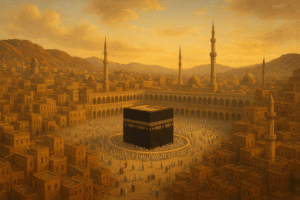
Umrah
This makes Saudi Arabia the spiritual heart of the Muslim world.
—
🚀 Modern Saudi Arabia (2000–Present)
Today, Saudi Arabia is undergoing major reforms under Vision 2030, led by Crown Prince Mohammed bin Salman (MBS).
Key modernization goals:
Diversifying the economy beyond oil
Tourism projects like NEOM, Red Sea Project
Growth in entertainment, sports, and technology
Increasing international investment
Social reforms, including more rights for women
Saudi Arabia is rapidly transforming into a modern and globally active nation.
—
🧠 Conclusion
The history of Saudi Arabia is a story of religion, unity, transformation, and global influence.
From the birthplace of Islam
to a unified kingdom
to a modern economic power—
Saudi Arabia’s past and present remain central to the world’s cultural and political landscape.