
H2: Introduction to the Legacy of Egypt
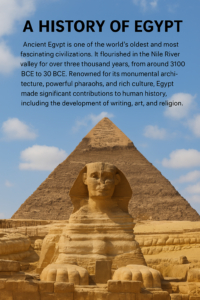
Ancient Egypt is one of the most iconic and influential civilizations in human history. Known for its pyramids, pharaohs, hieroglyphic writing, and breathtaking architecture, Egypt shaped the cultural and scientific foundations of many societies that came after it. Stretching along the fertile Nile River, Egypt developed a unique identity rooted in religion, agriculture, and powerful centralized rule. The history of Egypt spans more than 3,000 years, making it one of the longest-lasting civilizations in the world.
H2: The Birth of Civilization Along the Nile
H3: The Importance of the Nile River
The Nile River was the lifeline of Egyptian civilization. Its annual flooding brought fertile soil, allowing stable agriculture and enabling cities to grow. Early Egyptians developed advanced irrigation systems, which helped create surplus food and supported population growth. This stability allowed science, art, and culture to flourish.
H3: Unification of Upper and Lower Egypt
Around 3100 BCE, a powerful ruler known as King Narmer (or Menes) united Upper and Lower Egypt. This event marked the beginning of the First Dynasty and the start of the Early Dynastic Period. From this point forward, Egypt became a centralized kingdom ruled by a single pharaoh considered both a king and a divine figure.
H2: The Old Kingdom – Age of the Pyramids
H3: Rise of the Pharaohs
The Old Kingdom (2686–2181 BCE) is often called the “Age of the Pyramids.” Pharaohs gained immense religious and political power during this period. They were believed to be living gods responsible for maintaining order, harmony, and prosperity.
H3: Construction of the Great Pyramids
The most famous monuments of Egypt were built in this era, including:
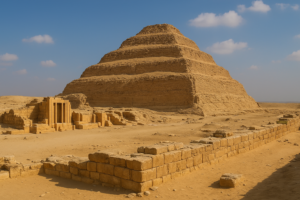
The Pyramid of Djoser at Saqqara
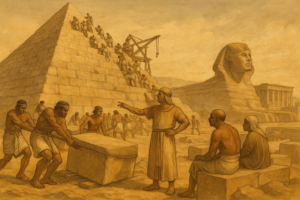
The Great Pyramid of Khufu at Giza
The Pyramids of Khafre and Menkaure
The construction of these structures required advanced engineering, mathematics, and logistics. Even today, the Great Pyramid remains one of the Seven Wonders of the Ancient World.
H3: Decline of the Old Kingdom
Eventually, political conflicts, poor harvests, and the weakening of pharaonic authority led to the collapse of the Old Kingdom, starting a period of instability known as the First Intermediate Period.
H2: The Middle Kingdom – A New Golden Age
H3: Reunification and Stability
Around 2050 BCE, King Mentuhotep II reunited Egypt and started the Middle Kingdom. This era brought political stability, economic growth, and cultural flourishing.
H3: Expansion and Trade
Egypt expanded its borders into Nubia to secure gold mines and valuable trade routes. Trade networks extended to the Levant, the Mediterranean, and even parts of Africa.
H3: Literature and Art
The Middle Kingdom is known for the rise of Egyptian literature, including wisdom texts, fictional stories, and religious writings that enriched the spiritual life of the people.
H2: The New Kingdom – Egypt at Its Peak
The New Kingdom (1550–1070 BCE) was the most powerful and prosperous era in Egyptian history.
H3: Famous Pharaohs and Military Power
This period saw the reign of legendary pharaohs such as:
Ahmose I – who expelled foreign Hyksos rulers
Hatshepsut – a powerful female ruler
Thutmose III – often called the “Napoleon of Egypt”
Akhenaten – who introduced monotheism
Tutankhamun – the boy king
Ramses II – one of the greatest pharaohs of all time
Egypt expanded its empire into the Middle East and parts of Africa, becoming a global superpower.
H3: Religion and Cultural Change
During this era, pharaoh Akhenaten attempted a radical religious shift by promoting worship of a single god, Aten. After his death, Egypt returned to its traditional polytheistic beliefs.
H3: Architecture and Temples
Gigantic temples and monuments were constructed, including:
Karnak Temple
Luxor Temple
Abu Simbel
Valley of the Kings
These structures symbolized Egypt’s power and religious devotion.
H2: The Decline of Ancient Egypt
H3: Invasions and Internal Struggles
After the New Kingdom, Egypt faced repeated invasions from foreign powers, including the Libyans, Nubians, and Assyrians. Internal conflicts and economic weakness further reduced its strength.
H3: Persian and Greek Conquest
In 525 BCE, Egypt fell to the Persian Empire. Later, in 332 BCE, Alexander the Great conquered Egypt and established the city of Alexandria, transforming Egypt into a center of Greek culture and science.
H2: The Roman Period and the End of the Pharaohs
H3: Cleopatra VII – The Last Pharaoh
The last major ruler of ancient Egypt was Cleopatra VII, known for her intelligence, diplomacy, and alliances with Julius Caesar and Mark Antony. After her defeat and death in 30 BCE, Egypt became a province of the Roman Empire, marking the end of the pharaonic age.
H3: Legacy of Ancient Egypt
Egypt’s contributions to architecture, astronomy, mathematics, medicine, and writing continue to influence the world. Hieroglyphics, mummification, massive temples, and the pyramids remain symbols of one of humanity’s greatest civilizations.
H2: Conclusion
The history of Egypt is a story of power, innovation, spirituality, and resilience. From the rise of the first pharaohs to its transformation under Greeks and Romans, Egypt shaped the identity of nations across the globe. It remains one of the most studied and admired civilizations in human history.