
Ancient Persia, known today as Iran, is one of the oldest cradles of human civilization. The Iranian Plateau has been inhabited for thousands of years, serving as a crossroads of cultures, trade, and ideas. The history of Ancient Persia is marked by powerful empires, advanced administrative systems, rich cultural traditions, and profound influence on the development of the ancient world.
Early Civilizations in the Iranian Plateau
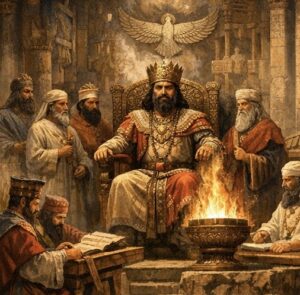
Archaeological evidence shows that human settlements existed in Iran as early as 7000 BCE. One of the earliest and most significant civilizations was Elam, which emerged in the southwestern region of modern-day Iran. The Elamites developed their own writing system, architecture, religious beliefs, and political structures. The city of Susa became a major cultural and administrative center and remained important for centuries.
Elam played a key role in regional politics and frequently interacted with Mesopotamian civilizations such as Sumer, Akkad, and Babylon. Despite repeated conflicts, Elamite culture deeply influenced later Persian traditions.
Arrival of the Indo-Iranians
Around the second millennium BCE, Indo-Iranian tribes migrated from Central Asia into the Iranian Plateau. These groups included the Medes, Persians, and Parthians. They brought with them Indo-European languages, social structures, and religious concepts that would later shape Persian identity.
The term “Iran” itself is derived from the word Aryan, meaning “noble” or “free people.” Over time, these tribes settled, merged with local populations, and laid the foundations of Persian civilization.
The Median Empire
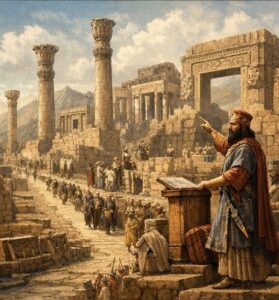
The Medes were the first Iranian people to establish a unified state. In the 7th century BCE, they formed a powerful kingdom under leaders such as Deioces, Phraortes, and Cyaxares. The Median capital, Ecbatana (modern-day Hamadan), became a political and cultural center.
The Medes played a decisive role in overthrowing the Assyrian Empire, one of the most brutal powers of the ancient Near East. Their success paved the way for the rise of the Persians and marked the beginning of Iranian dominance in the region.
The Achaemenid Empire
The rise of the Achaemenid Empire in the 6th century BCE marked a turning point in world history. Founded by Cyrus the Great, the empire rapidly expanded to become the largest the world had ever seen, stretching from the Indus Valley to the Mediterranean Sea.
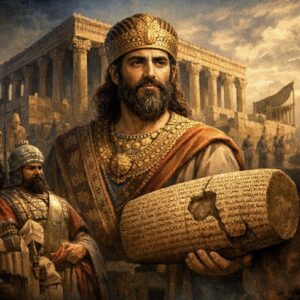
Cyrus was renowned for his policy of tolerance and respect for local customs and religions. His capture of Babylon without bloodshed and the issuance of the Cyrus Cylinder, often regarded as the world’s first charter of human rights, earned him lasting admiration.
Administration and Achievements under Darius I
Under Darius I (Darius the Great), the Achaemenid Empire reached its peak of organization and efficiency. Darius divided the empire into provinces known as satrapies, each governed by a satrap. This system ensured effective administration while allowing regional autonomy.
Darius introduced a standardized taxation system, built an extensive network of roads—including the famous Royal Road—and promoted trade and communication across the empire. Monumental architectural projects such as Persepolis symbolized imperial power and artistic excellence.
Religion and Culture in Achaemenid Persia
Religion played an important role in Persian society. Zoroastrianism, attributed to the prophet Zarathustra (Zoroaster), emphasized moral dualism, the struggle between good and evil, and individual responsibility. These ideas influenced later religious traditions, including Judaism, Christianity, and Islam.
Persian art and culture blended influences from Mesopotamia, Egypt, Anatolia, and Central Asia, resulting in a unique and sophisticated civilization.
The Fall of the Achaemenid Empire
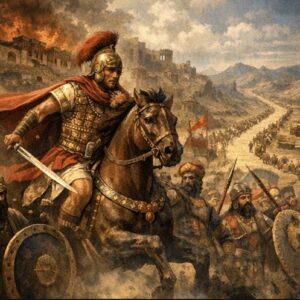
In the late 4th century BCE, the Achaemenid Empire faced internal weaknesses and external threats. Alexander the Great of Macedon launched a successful campaign against Persia, defeating Darius III and capturing major cities.
Although Alexander caused significant destruction, Persian culture survived. After his death, his empire fragmented, and Persia entered a new phase under Hellenistic rule.
The Seleucid and Parthian Periods
Following Alexander’s death, Persia fell under the control of the Seleucid Empire, a Hellenistic state. However, Greek dominance was short-lived. In the 3rd century BCE, the Parthians (Arsacids) rose to power and restored Iranian independence.
The Parthian Empire was decentralized, relying on a feudal system. Despite this, the Parthians successfully resisted Roman expansion for centuries. They also revived Persian traditions and played a crucial role in Silk Road trade, connecting East and West.
The Sassanian Empire
In the 3rd century CE, the Sassanian Empire replaced the Parthians and marked the final great era of Ancient Persia. Founded by Ardashir I, the Sassanians established a centralized government and declared Zoroastrianism the state religion.
The Sassanian period was a golden age of Persian art, science, and philosophy. Cities such as Ctesiphon and Gondishapur became centers of learning. The Academy of Gondishapur was one of the most advanced educational institutions of the ancient world.
Wars and Decline
The Sassanians frequently engaged in prolonged wars with the Roman and Byzantine Empires. While they achieved notable victories, these conflicts drained resources and weakened the state. Internal political struggles and social inequality further destabilized the empire.
In the 7th century CE, Arab Muslim armies invaded Persia. After decisive battles, the Sassanian Empire collapsed, marking the end of Ancient Persian rule.
Legacy of Ancient Persia
Despite its fall, Ancient Persia left an enduring legacy. Persian concepts of governance, law, architecture, and religious thought influenced Islamic civilization and later European societies. Ideas of justice, tolerance, and administrative efficiency remain hallmarks of Persian heritage.
Conclusion
The history of Ancient Persia is a story of resilience, innovation, and cultural brilliance. From early civilizations to mighty empires, Persia shaped the ancient world in profound ways. Understanding this rich history provides valuable insight into the roots of Iranian identity and the foundations of global civilization.