
England, one of the most historically influential countries in the world, is located in the southern part of the island of Great Britain. Its history spans thousands of years, shaped by invasions, monarchies, wars, cultural movements, and political transformations. From ancient tribal societies to a modern constitutional monarchy, England’s past has played a crucial role in shaping not only Europe but the global order.
Prehistoric and Ancient England
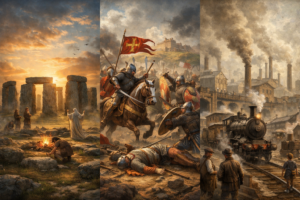
Human presence in England dates back to prehistoric times. Archaeological discoveries suggest that early humans lived in the region over 800,000 years ago. During the Stone Age, people relied on hunting, gathering, and later farming. One of the most iconic prehistoric monuments in the world, Stonehenge, was constructed around 3000–2000 BCE. Its exact purpose remains debated, but it is believed to have had religious or astronomical significance.
Before the Roman invasion, England was inhabited by Celtic tribes, particularly the Britons. These tribes had their own languages, traditions, and social structures. They lived in small kingdoms and were skilled in metalwork, agriculture, and warfare.
Roman Britain (43–410 CE)
In 43 CE, the Roman Empire invaded Britain under Emperor Claudius. England became part of the Roman province of Britannia. The Romans introduced advanced infrastructure, including roads, bridges, baths, towns, and fortified cities such as Londinium (modern London).
Roman rule brought law, order, trade, and Roman culture to England. Christianity began to spread during this period. However, Roman control was never absolute, especially in the northern regions. By the early 5th century, due to internal problems and external threats, the Roman legions withdrew, leaving Britain vulnerable.
Anglo-Saxon Period (5th–11th Century)
After the Roman withdrawal, Germanic tribes known as the Angles, Saxons, and Jutes migrated to England. These groups gradually formed several kingdoms, including Wessex, Mercia, and Northumbria. The name “England” originates from the Angles.
This era saw the development of the Old English language, early English laws, and Christianization, largely influenced by missionaries such as St. Augustine of Canterbury. Society was largely rural, and power was held by kings and local lords.
One of the most significant challenges of this period was the Viking invasions from Scandinavia. Vikings raided, settled, and ruled parts of England. King Alfred the Great of Wessex successfully defended his kingdom and laid the foundations for a united England.
Norman Conquest (1066)
A turning point in English history occurred in 1066, when William the Conqueror, Duke of Normandy, defeated King Harold II at the Battle of Hastings. This event, known as the Norman Conquest, transformed England politically, socially, and culturally.
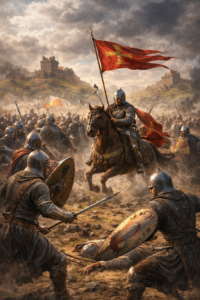
The Normans introduced feudalism, built castles across the country, and replaced much of the Anglo-Saxon elite. French became the language of the ruling class, influencing the development of Middle English. The Domesday Book (1086), a detailed survey of land and resources, demonstrated the strength of centralized royal authority.
Medieval England (12th–15th Century)
During the Middle Ages, England experienced significant political and social changes. One of the most important documents in world history, the Magna Carta, was signed in 1215. It limited the power of the king and established the principle that even the monarch was subject to the law.
England was frequently involved in wars, including the Hundred Years’ War against France. This conflict strengthened national identity but caused economic strain. The Black Death in the 14th century killed a large portion of the population, leading to labor shortages and social change.
The medieval period ended with the Wars of the Roses, a series of civil wars between rival noble families. These conflicts concluded in 1485 with the rise of Henry VII, founder of the Tudor dynasty.
Tudor England (1485–1603)
The Tudor era was marked by strong monarchy and major religious change. Henry VIII famously broke away from the Roman Catholic Church, establishing the Church of England. This led to the English Reformation and significant religious conflict.
Under Elizabeth I, England entered a golden age. The country became more stable, expanded overseas exploration, and defeated the Spanish Armada in 1588. Literature and culture flourished, with figures such as William Shakespeare leaving a lasting legacy.
The Stuart kings faced conflicts between royal authority and Parliament. These tensions led to the English Civil War (1642–1651), resulting in the execution of King Charles I and the temporary establishment of a republic under Oliver Cromwell.
Although the monarchy was restored in 1660, its power was permanently reduced. The Glorious Revolution of 1688 established a constitutional monarchy and strengthened parliamentary democracy. The Bill of Rights (1689) laid the foundation for modern British governance.
Industrial Revolution and British Empire
In the 18th and 19th centuries, England became the birthplace of the Industrial Revolution. Innovations in machinery, transportation, and manufacturing transformed society. Cities grew rapidly, and England became a global economic power.
At the same time, England was at the heart of the British Empire, which expanded across Asia, Africa, and the Americas. While the empire brought wealth and influence, it also caused exploitation and conflict in colonized regions.
Modern England (20th–21st Century)
England played a central role in both World War I and World War II, suffering heavy losses but emerging as a key Allied power. After the wars, the empire gradually declined, and many colonies gained independence.
In the modern era, England is part of the United Kingdom, operating under a constitutional monarchy with a democratic government. London is a global center for finance, culture, and politics.
Today, England is known for its rich history, cultural diversity, legal traditions, and global influence. Its past continues to shape its identity and role in the world.
Conclusion
The history of England is a story of transformation, resilience, and influence. From ancient tribes and Roman rule to monarchy, industrial power, and modern democracy, England has continuously evolved. Its historical experiences have contributed significantly to global culture, law, and political systems, making England one of the most historically significant nations in human history.