
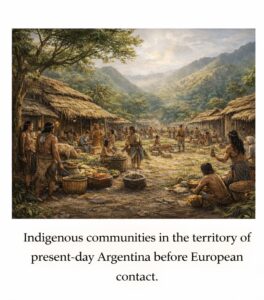
Argentina is one of the most important nations in South America, with a history shaped by indigenous heritage, European colonization, large scale immigration, political conflict, economic transformation, and cultural creativity. Long before Europeans arrived, the territory that later became Argentina was inhabited by diverse indigenous peoples such as the Mapuche, Guaraní, Diaguita, Querandí, and Comechingón. These groups developed unique social systems, spiritual beliefs, and economic activities adapted to their environments. Agriculture, hunting, fishing, and regional trade formed the foundation of their daily lives, while oral traditions preserved knowledge and identity across generations.
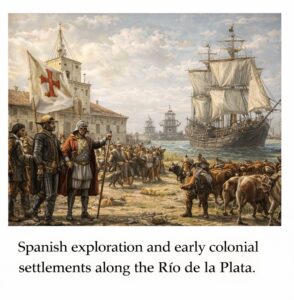
The first European contact occurred in 1516 when Spanish explorer Juan Díaz de Solís reached the Río de la Plata. This event opened the region to Spanish exploration and eventual colonization. During the following decades, Spain attempted to establish permanent settlements, facing resistance from indigenous communities and challenges from geography and limited resources. Buenos Aires was initially founded in 1536 but was abandoned due to conflict and scarcity. In 1580, the city was re founded and gradually became a strategic port that connected the interior of South America .
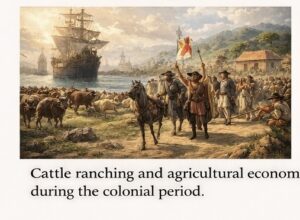
Throughout the colonial period, Argentina was governed as part of the Viceroyalty of the Río de la Plata. Spanish authorities imposed political control, economic regulations, and cultural influence. Catholicism became the dominant religion, while Spanish language and customs shaped daily life. The economy focused on cattle ranching, agriculture, and the export of raw materials such as leather and meat. The fertile Pampas region proved especially valuable, helping to establish Argentina as a significant agricultural producer within the Spanish Empire.
Despite economic growth, colonial rule created deep social inequalities. Power remained concentrated among Spanish elites, while indigenous peoples and lower classes faced exploitation and limited rights. By the late eighteenth century, new political ideas began to circulate. Enlightenment philosophy, along with the American and French Revolutions, inspired local leaders to question colonial authority. Tensions increased as Spain attempted to maintain control over trade and governance.
The May Revolution of 1810 marked a decisive moment in Argentine history. Local leaders in Buenos Aires removed the Spanish viceroy and formed a governing council. Although independence was not immediately achieved, the revolution initiated a prolonged struggle for sovereignty. After years of conflict, Argentina officially declared independence from Spain on July 9, 1816. This declaration represented a major step toward national identity, although unity and stability remained uncertain.
The nineteenth century was characterized by internal conflict and nation building. Political struggles emerged between centralists, who favored strong authority in Buenos Aires, and federalists, who supported provincial autonomy. These conflicts led to periods of violence and instability. However, the country also experienced economic expansion driven by agricultural exports and foreign investment. Railways, ports, and infrastructure projects transformed the landscape and integrated Argentina into global markets.
Massive European immigration during the late nineteenth and early twentieth centuries reshaped Argentine society. Millions of immigrants arrived, primarily from Italy and Spain, but also from Germany, France, and Eastern Europe. They contributed labor, skills, and cultural traditions, influencing language, cuisine, music, and urban life. Buenos Aires evolved into a cosmopolitan city, often compared to European capitals, while education and literacy expanded rapidly.
By the early twentieth century, Argentina ranked among the world’s wealthiest nations. Economic prosperity supported social mobility and cultural development. However, inequality and political exclusion persisted. The introduction of democratic reforms expanded participation, but instability continued. Military interventions became frequent, reflecting tensions between civilian governments and armed forces.
One of the most influential figures in modern Argentine history was Juan Domingo Perón. Emerging in the mid twentieth century, Perón promoted social justice, labor rights, and national sovereignty. His movement, known as Peronism, transformed politics and society, empowering workers and reshaping the relationship between the state and the population. At the same time, Peronism generated strong opposition and deep political divisions that continue to influence Argentina today.
The latter half of the twentieth century was marked by periods of military dictatorship, human rights abuses, and economic crisis. The military government that ruled between 1976 and 1983 committed widespread violations, leaving lasting trauma. The return to democracy in 1983 represented a turning point, restoring civil liberties and democratic institutions. However, economic instability remained a challenge, including inflation, debt, and social inequality.
Despite these difficulties, Argentina developed a powerful cultural identity. Tango music and dance emerged as global symbols of passion and expression. Literature, cinema, and art reflected social realities and historical memory. Football became a unifying force, producing legendary players and international success. Cultural creativity served as both resistance and resilience during periods of hardship.
In the twenty first century, Argentina continues to navigate economic fluctuations, political debate, and social change. Its history remains a complex narrative of struggle, adaptation, and cultural richness. From indigenous roots to global influence, Argentina’s past shapes its present and future. The nation stands as a testament to the enduring impact of history on identity, society, and collective memory, maintaining a significant role within Latin America and the wider world today.
This article is written to provide general historical information in a simple and clear way.