
Brazil, the largest country in South America and the fifth largest in the world, has a rich and complex history shaped by indigenous civilizations, European colonization, slavery, empire, republic, and modern democratic struggles. Its past is marked by cultural diversity, economic transformation, and social challenges that continue to influence the nation today.
Indigenous Brazil Before European Contact
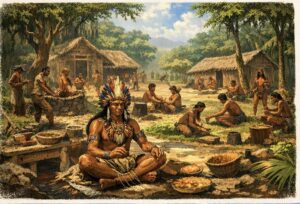
Long before the arrival of Europeans, Brazil was inhabited by millions of indigenous people belonging to hundreds of distinct tribes and cultures. Archaeological evidence suggests that humans lived in the region for at least 12,000 years. These early inhabitants developed diverse ways of life depending on geography, including hunting, fishing, agriculture, and trade.
Major indigenous groups such as the Tupi, Guarani, Ge, and Arawak lived across vast territories. They cultivated crops like manioc (cassava), maize, sweet potatoes, and peanuts. Indigenous societies had complex social structures, spiritual beliefs connected to nature, and rich oral traditions. Contrary to early European misconceptions, these societies were well adapted to their environments and maintained extensive networks of communication and exchange.
Portuguese Discovery and Colonization (1500–1700)
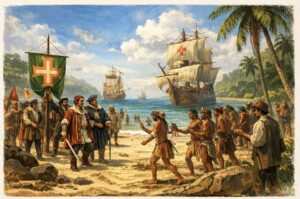
Brazil entered written history in April 1500 when Portuguese explorer Pedro Álvares Cabral landed on its coast while sailing to India. He claimed the land for Portugal, naming it Terra de Santa Cruz. Later, it became known as Brazil, named after the brazilwood tree, a valuable source of red dye.
Initially, Portugal showed little interest in colonizing Brazil, focusing instead on trade routes to Asia. However, increasing threats from other European powers, particularly France, forced Portugal to establish permanent settlements. In the 1530s, Portugal divided Brazil into hereditary captaincies, granting land to nobles responsible for administration and defense.
Sugar cane cultivation soon became the backbone of the colonial economy. Large plantations, known as engenhos, were established along the northeastern coast. To meet labor demands, the Portuguese first enslaved indigenous people and later imported millions of Africans through the transatlantic slave trade. Brazil would eventually become the largest destination for enslaved Africans in the world.
Slavery and Colonial Society
Slavery profoundly shaped Brazilian society. Between the 16th and 19th centuries, an estimated 4.5 to 5 million Africans were forcibly brought to Brazil. Enslaved Africans worked on plantations, in mines, urban centers, and households. Despite brutal conditions, they preserved elements of their cultures, religions, music, and languages, which deeply influenced Brazilian identity.
Colonial society was highly stratified. At the top were Portuguese-born elites, followed by locally born whites, mixed-race individuals, free blacks, and enslaved people at the bottom. Resistance to slavery was constant. Enslaved Africans escaped and formed independent communities called quilombos, the most famous being Quilombo dos Palmares, which resisted Portuguese rule for decades.
The Gold Rush and Economic Expansion (1700–1800)
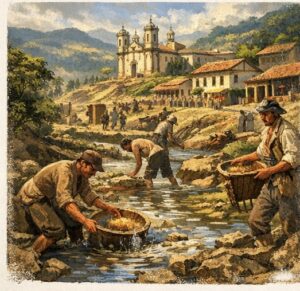
In the late 17th century, gold was discovered in the interior region of Minas Gerais. This discovery transformed Brazil’s economy and shifted the colonial center of power from the northeast to the southeast. Thousands of settlers migrated to mining regions, leading to rapid urbanization and increased Portuguese control.
The gold boom enriched Portugal but imposed heavy taxes on the colony, causing widespread dissatisfaction. Cultural life flourished during this period, with the emergence of baroque art, architecture, and literature, particularly in cities like Ouro Preto.
The Royal Court in Brazil and Independence (1808–1822)
A turning point in Brazilian history came in 1808 when the Portuguese royal family fled to Brazil to escape Napoleon’s invasion of Portugal. For the first time, a European monarchy ruled from a colony. Rio de Janeiro became the capital of the Portuguese Empire.
This event brought significant changes: ports were opened to international trade, institutions such as banks, universities, and printing presses were established, and Brazil gained greater autonomy. When King João VI returned to Portugal in 1821, his son Dom Pedro remained in Brazil.
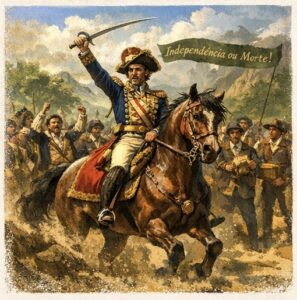
On September 7, 1822, Dom Pedro declared Brazil’s independence from Portugal. Unlike many Latin American countries, Brazil became a constitutional monarchy rather than a republic. Dom Pedro I became the first Emperor of Brazil.
The Brazilian Empire (1822–1889)
Brazil’s imperial period was marked by political stability compared to its neighbors. After Dom Pedro I abdicated in 1831, his son Dom Pedro II ascended the throne. His long reign brought economic growth, modernization, and relative unity.
Coffee replaced sugar as Brazil’s main export, especially in the southeastern regions of São Paulo and Rio de Janeiro. Railways, telegraphs, and improved infrastructure supported economic expansion. However, slavery remained central to the economy, drawing international criticism.
Abolition of Slavery
By the late 19th century, abolitionist movements gained strength. Pressure came from enslaved people, intellectuals, international actors, and economic changes. Gradual reforms were introduced, including the Law of Free Birth (1871) and the Sexagenarian Law (1885).
Finally, on May 13, 1888, Princess Isabel signed the Lei Áurea (Golden Law), officially abolishing slavery in Brazil. Brazil was the last country in the Western Hemisphere to do so. However, freed people received no land, compensation, or support, leading to long-term social inequality.
The Republic and Political Instability (1889–1930)
In 1889, the monarchy was overthrown in a military coup, and Brazil became a republic. The First Republic was dominated by regional elites, particularly coffee producers from São Paulo and dairy farmers from Minas Gerais, in a system known as “coffee with milk” politics.
While the economy grew, democracy was limited. Elections were often fraudulent, and most citizens had little political power. Social unrest increased as industrialization slowly expanded.
The Vargas Era and Modernization (1930–1945)
In 1930, Getúlio Vargas came to power through a revolution. His rule transformed Brazil. Vargas centralized authority, promoted industrialization, and introduced labor laws, including minimum wages and workers’ rights.
In 1937, he established an authoritarian regime known as the Estado Novo. Despite repression, Vargas modernized the economy and strengthened national identity. Brazil joined the Allies during World War II, sending troops to fight in Europe.
Democracy, Dictatorship, and Development (1945–1985)
After World War II, Brazil experienced a brief democratic period marked by rapid industrial growth. Brasília, the new capital, was inaugurated in 1960 as a symbol of modernization.
In 1964, a military coup overthrew the civilian government, leading to a dictatorship that lasted 21 years. The regime promoted economic growth, known as the “Brazilian Miracle,” but at the cost of censorship, torture, and human rights abuses.
Return to Democracy and Contemporary Brazil (1985–Present)
In 1985, Brazil returned to civilian rule. A new democratic constitution was adopted in 1988, guaranteeing civil rights and freedoms. Since then, Brazil has faced challenges including corruption, economic inequality, political polarization, and environmental issues.
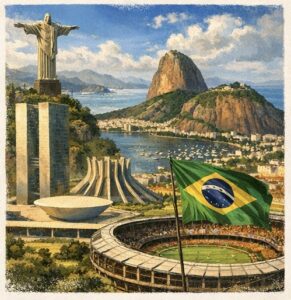
Despite difficulties, Brazil has become a major global player, known for its cultural influence, biodiversity, agriculture, and emerging economy. Events such as hosting the 2014 World Cup and the 2016 Olympic Games highlighted Brazil’s international role.
Conclusion
Brazil’s history is a story of resilience, diversity, and transformation. From ancient indigenous civilizations to colonial exploitation, from empire to republic, and from dictatorship to democracy, Brazil has continuously reinvented itself. Understanding its past is essential to understanding its present and shaping its future as a nation of immense potential and complexity.