
Japan is one of the most well-known and culturally rich countries in the world. Located in East Asia, this island nation has a unique history shaped by geography, tradition, isolation, and innovation. Over thousands of years, Japan developed a strong national identity while adapting foreign influences in its own distinctive way. From ancient tribal societies to a modern technological power, Japan’s historical journey is both complex and fascinating.
Ancient Japan and Early Settlements
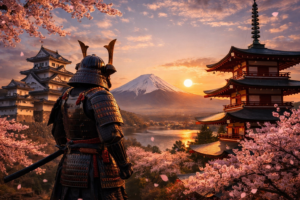
The earliest evidence of human settlement in Japan dates back more than 30,000 years. One of the first significant historical periods is the Jōmon period (approximately 14,000 BCE–300 BCE). People during this time lived as hunter-gatherers and are known for producing some of the oldest pottery in the world. These early communities laid the foundation for Japanese culture through their close relationship with nature.
Following the Jōmon period, the Yayoi period began around 300 BCE. This era introduced rice farming, metal tools, and more organized social structures. Agriculture transformed Japanese society, leading to population growth and the emergence of village-based communities.
The Rise of the Japanese State and Chinese Influence
Between the 3rd and 8th centuries CE, Japan experienced significant cultural and political development. During the Asuka and Nara periods, Japan adopted many elements from Chinese civilization, including written language (kanji), Buddhism, Confucian ideas, and centralized government systems.
Buddhism played a major role in shaping Japanese art, architecture, and philosophy. Large temples were built, and the emperor became a symbolic figure representing unity and divine authority. The establishment of a permanent capital in Nara marked a key step in state formation.
The Heian Period and Cultural Flourishing
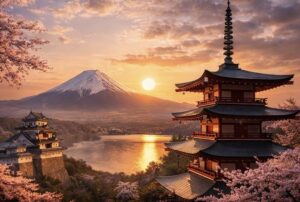
The Heian period (794–1185) is often considered a golden age of Japanese culture. The capital was moved to Kyoto, and a refined court culture developed. Japanese art, literature, and poetry flourished, leading to the creation of unique cultural traditions distinct from Chinese influence.
One of the most important literary works of this period is The Tale of Genji, written by Murasaki Shikibu. It is widely regarded as one of the world’s earliest novels. During this time, Japan developed its own writing systems, such as hiragana and katakana, strengthening its cultural independence.
The Rise of the Samurai and Feudal Rule
From the late 12th century onward, political power shifted from the imperial court to the military class. The samurai emerged as the dominant force, and Japan entered a long period of feudal rule under military governments known as shogunates.
The Kamakura Shogunate marked the beginning of warrior rule, followed by centuries of internal conflict. Loyalty, honor, and discipline became central values of samurai culture. Despite frequent wars, these values deeply influenced Japanese society and ethics.
The Edo Period and National Isolation
In the early 17th century, the Tokugawa Shogunate established peace and stability, beginning the Edo period (1603–1868). During this time, Japan adopted a policy of national isolation, limiting contact with foreign countries to preserve internal order.
This isolation allowed Japanese culture, art, and economy to develop independently. Cities grew, commerce expanded, and cultural forms such as kabuki theater, haiku poetry, and traditional woodblock prints became popular. Although politically closed, Japan experienced significant internal growth.
The Meiji Restoration and Modernization
In 1868, Japan underwent a major transformation known as the Meiji Restoration. The shogunate was abolished, and power was restored to the emperor. Japan rapidly modernized by adopting Western technologies, military systems, education models, and industrial practices.
This period marked Japan’s transition from a feudal society to a modern nation-state. Railways, factories, and modern institutions were established, enabling Japan to compete with Western powers. By the early 20th century, Japan had become a major regional power.
Japan in the Twentieth Century
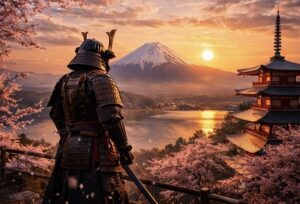
The twentieth century brought both expansion and hardship. Japan became involved in international conflicts and played a significant role in World War II. After the war, Japan faced devastation but began a remarkable recovery.
With strong economic reforms, investment in education, and technological innovation, Japan experienced rapid growth during the post-war decades. This period is often called the Japanese economic miracle, transforming the country into one of the world’s leading economies.
Contemporary Japan
Today, Japan is a modern democratic nation known for its advanced technology, strong economy, and rich cultural heritage. Cities like Tokyo, Osaka, and Kyoto are global centers of finance, culture, and tourism.
Japan successfully balances tradition and modernity, preserving ancient customs while embracing innovation. Its influence can be seen worldwide in technology, art, education, and popular culture.
Conclusion
The history of Japan is a story of resilience, adaptation, and cultural continuity. From ancient settlements to a modern global power, Japan has followed a unique path shaped by its people, geography, and values. Understanding Japan’s history provides valuable insight into how tradition and progress can coexist, making it one of the most remarkable nations in the world.